HighPoint RocketRAID 2680 and RocketRAID 4320 SAS/ SATA cards
Mar 29th, 2009 | By Anthony
HighPoint RocketRAID 2680 and RocketRAID 4320 SAS/ SATA cards
Date
: 03/30/09 – 01:40:16 AM
Author
:
Category
: Storage
Page 1 : Introduction
Note:
As of March 16th, Newegg has the RocketRAID 4320 listed for $329.00 down from $619.00.
Manufacturer:
HighPoint
From the enormous selection and combinations of processors, motherboards, memory and video cards available, storage performance is easily brushed aside. While high end storage products are not foreign to consumer systems, often for most users the most appropriate solutions are either high speed hard drives, basic RAID arrays, or the combination of the two. The question is then: why are we taking the time today to review RAID cards?
We can rationalize the thousands upon thousands of bytes in more manageable and understandable forms such as the number of songs, pictures, or videos a disk drive can hold. However, no matter how we numerically struggle to fathom the sheer amount of digital data that we can fit on a single hard disk, what we can logically pile away trumps sensibility. From megabytes, to gigabytes, and now, on the fringes of the terabytes, storage technology continually conquers new milestones with no end in sight.

In recent times, a few interesting things have happened and have shaken up the storage playing field. On the hardware side of things, not only has the cost of storage continually become cheaper (as always), but for the first time in years hard drive technology is really changing. Not too long ago, solid state drives or SSD's entered the market. While not perfect, each consecutive product improved upon the last considerably. While not the most effective cost per GB solution, it did offer the jaw dropping speeds typically found in more expensive RAID setups. For sheer capacity, conventional mechanical hard drives offer all the gigabytes and even a few terabytes to satisfy even the most persistent hoarders. Digital content has never been so plentiful, whether through various digital media services, shared content or even home produced media such as audio, video and picture there is plenty of content that needs storing that just isn't going to fit in your mom and dad's conventional 80GB hard drives. Whether users are looking to boost system performance, capacity or redundancy for data, RAID is an obvious choice.
At one time or another, all computer users have or will face data loss whether it is simply losing a bookmark, erasing a part of a document, misplacing a USB device or something catastrophic such a hard disk failure. As we rely more and more on these devices to host our day to day computing applications, store memories or entertainment, the threat- or rather the seriousness of losing a disk is increasingly severe, thus more and more users are looking towards storage redundancy. Still however, why hardware RAID? Hardware RAID is expensive, besides the obvious cost of additional hard drives, RAID cards cost quite a bit. For simple RAID solutions, software RAID solutions is quite sufficient, however when we increase the number of drives in an array, perhaps it is time to look into hardware solutions.

Around enthusiast circles, hardware RAID and manufacturers of such products do not often find themselves sharing the spotlight with more typical performance hardware such as video cards and motherboards, but the game has changed and we are excited to welcome HighPoint to our site. HighPoint although probably an unfamiliar name for quite a number of people, has been producing RAID solutions for a decade and a half. Among their extensive list of customers are companies such as Google, Adaptec, SunMicro, Maxtor, Hitachi, San Disk, HP and Lenovo- without a doubt, an impressive track record. Today we will be looking at two RAID solutions by HighPoint, the Rocket RAID 2680 and Rocket RAID 4320.
Page 2 : Features and Specifications
As you can imagine, the RocketRAID 2680 from HighPoint is all about cost effectiveness and value. The RocketRAID 2680 is a PCI Express x4 card with a built in XOR processor and directly supports up to eight SAS or SATA hard drives, however through an expander, it can support up to 128 hard drives. The card can be managed either through its own BIOS at startup or through a web interface with Quick or Background initialization modes for instant RAID setup.


While it can neither wash your car nor clean your stove, its higher end counterpart, the RocketRAID 4320 is another story.


The RocketRAID 4320 has its own processor running at 1.2 GHz, IO processor for parity calculations and 256MB of ECC SDRAM. The card runs PCI- Express x8 for all your bandwidth needs and like the RocketRAID 2680 supports either eight SAS or SATA drives through the two mini SAS ports or through an expander up to 128 drives.
Page 3 : Package and Content
The Rocket RAID 2680 and 4320 cards are packed away in matching card board boxes.

The boxes are plain and without the typical flashy graphics found on other hardware. With the purchase of a RAID card, I have my doubts that fancy graphics and claims will sway ones decision anyways.


Across the panels of the boxes, HighPoint gives a quick rundown of key features and specifications, of course a more detailed outline can be found on their website.


On the back, we have more product specifications and a listing of compatibility information


Both units come with the same accessories: manual, drivers, two mini SAS cables, a short back plate and screws.


We will have a look at both of these two cards, starting with the RocketRAID 2680.


In terms of physical capability, well given the availability of a PCI- Express slot, it should be no concerns with compatibility.

The card itself fits into any PCI- Express slots however through jumper settings can be configured to run in either x1 or x4 settings.

On the end of the card, we have the two mini SAS connectors. SAS is backwards compatible with SATA so a mini SAS to SATA connector can be used to connect SATA type drives.

Next, let's have a look at the RocketRAID 4320.

The card itself is significantly larger and even has active cooling, unfortunately it is a small, presumably loud 4cm fan, but chances are you won't be hearing that over your stack of hard drives.

On the end, we again have two mini SAS connectors.

On the opposite end, we have an Ethernet connector- this card can be used to setup a RAID array as a network drive!

Before we head into installation, we will have one final look at the cards.

Both the RocketRAID 2680 and 4320 are low profile one- slot cards and should not be an issue fitting into any system.
Page 4 : Hardware Installation
The bulk of the installation section will cover the software side of things. We will however begin with the hardware.


Page 5 : HighPoint RocketRAID 2680 Configuration
The RocketRAID 2680 can be configured either through its BIOS or through a website interface. We will be configuring both methods.
Following the system POST screen, the user is presented with the card's initialization screen; during this process pressing CTRL+ H loads the RAID card's BIOS.

On the main screen, we have a listing of the hard drives attached to the card and if there are any existing RAID configurations present, they are listed below.

Menus above can be accessed by either hitting Alt along with the corresponding first letter of each menu or navigated through with the arrow key; it's fairly straight forward here. Let's begin with creating a RAID 0 array. Hitting ALT+C brings up the creation menu.

After selecting the level of RAID, another menu is presented. This one allows the user to name the array, select drives in which to be used and the size of the array.

Disk selection is done by hutting the enter key while going thought he list.

Lastly, select the capacity of the array and hit create!
Page 6 : HighPoint RocketRAID 4320 Configuration
The RocketRAID 4320 is a bit different.

Again, using CTRL+ H to enter the BIOS we have the same general layout, with the drives shown first then the arrays along with a menu bar towards the top, only this time with a few more buttons.

Before anything can be done, we will first need to switch the administrative mode from User to Supervisor. Pressing Alt along with the first letter of the menu items again activates the controls.

The Disk menu allows the configuration of individual disks such as initialization, setting up spare drives for existing arrays, write cache settings and for displaying drive related information.

The following menu: Array is used to setup various RAID configurations.

Selecting 'create' brings up another screen allowing the selection of drives for the array.

Following that, the settings for the RAID array are selected. Again, it's all very intuitive.

Next, we have the controller menu. This allows the configuration of network settings, card related settings and shows the event log.
Page 7 : Software Setup
Following the installation of the included drivers and utilities, the RAID cards can be accessed through the web interface via a predetermined address. This is exceptionally handy in larger work spaces, or where the system is non- local.

Use the default username: RAID and default password: hpt to log into the system.

We have the same familiar interface again.

Hitting the Create Array button brings the interface to another screen where the array is configured.

Under the submenu of Manage is Disks which allows viewing of individual disk status and configurations.

Hard drive health is reported through SMART.

Finally, we have the event log.

Page 8 : Testing Setup
For testing, we will be using two pieces of software, IO Meter and SiSoftware Sandra. The operating system, Windows XP along with testing software are installed on a separate IDE hard drive allowing the drives attached to the RAID controllers to be as isolated from the overall system as possible.
Firmware V1.1 will be used for the RocketRAID 2680 and v1.2.12.11 for the RocketRAID 4320.

First, let's talk about Iometer
Iometer can be used for measurement and characterization of:
-Performance of disk and network controllers.
-Bandwidth and latency capabilities of buses.
-Network throughput to attached drives.
-Shared bus performance.
-System-level hard drive performance.
-System-level network performance.
We will be testing three different RAID solutions, the Rocket RAID 2680, Rocket RAID 4320 and the integrated ICH9R chipset on the DFI X38 motherboard. Each of these tests will consist of RAID 0 and RAID 5 configurations in six and eight hard drive setups, except for the ICH9R which will only be run with 6 hard drives due its limitations. Our goal for today is to look at how an integrated chipset stacks up against the budget and value oriented RocketRAID 2680 and how lower end solutions such as onboard and low end cards stack up against more expensive, featured filled cards such as the RocketRAID 4320.
Page 9 : Iometer: IO Performance
Six Drives
A lot of a hard drive's performance has to do with the environmental factors involved and the types of files it is dealing with. Our first set of tests will look at I/Os per second, or the number of requests completed by the RAID array in a second. To do so, we will be using Intel's pre-defined File Server access pattern which is a distribution of file sizes in varying percentages with predominantly random reading.

The bulk of file sizes dealt with by the File Server access pattern is 4 KB which is reflective of the number of small files a typical system processes, either through the user, operating system or file system.

Comparing RAID 0 and RAID 5 array setups in a six drive comparison, the ICH9R chipset held on fairly well, in RAID 0 that is. At a low system load of four or less requests, or queue depth each of the RAID systems we tested were comparable, but with heavier loads towards the right of the graph, RAID 5 on the ICH9R was left behind.

Eight Drives
Due to technical limitations of the ICH9R chipset allowing only a maximum of 6 disks, it will not be present in the next test. We will again be using Intel's File System access specification.

With eight hard drives, the RocketRAID 4320 really shines. In both RAID 0 and 5 configurations, the RocketRAID 4320 pulls away from the RocketRAID 2680. Comparing RAID 5 performance levels between the two cards, the performance gap is even more apparent.

Comparing RAID 0 performance between the three setups in six and eight hard drive configuration by plotting them all on the same axis is perhaps more representative comparison of IO performance capabilities. With six hard drives, the ICH9R chipset managed to reach a higher IO/s measure by the end of the tests than either HighPoint cards. Marginally, however it's still noteworthy. With the addition of more hard drives into the system, we noticed some significant gains in performance, especially with the RocketRAID 4320.

Unlike RAID 0, RAID 5 requires quite a bit of processing power, processing power in which an integrated chipset often lacks. At a Queue Depth of 256, representing an incredibly heavy system load the ICH9R maxed out just above 1000 IO/s.
Page 10 : Iometer: Throughput Performance
Throughput is measured in two ways, sequential and random. Reading and writing sequential data is of course much faster than random access due to the time it takes for the disk head on the actuator arm of a hard drive to position itself and either retrieve or write data.


In RAID 0, surprisingly the RocketRAID 2680 landed in last place, with the Intel ICH9R chipset trailing behind the RocketRAID 4320. While a number of reasons can be offered that would explain the poor presentation with the RAID 0 tests, the fact still remains that the numbers here are not looking good. With sequential reading and writing the RocketRAID 2680 held only a small margin over the ICH9R chipset, both of which followed behind the RocketRAID 4320 by a much larger gap. However, with random reading and writing both HighPoint cards and the ICH9R chipset took a massive performance hit, as expected of course. However, while the RocketRAID 4320 still managed to pull through as the fastest of the pack, only barely. The RocketRAID 2680 on the other hand dropped to a low of 74 MB/s.

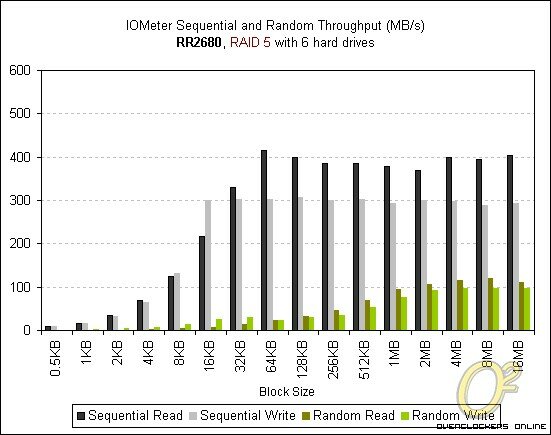

In RAID 5, things were a world of difference. Having a look at sequential read performance first the ICH9R chipset was clearly out of its league. Even though with random read the chipset managed to stay comparable, weighed against the vast difference in sequential performance the HighPoint cards clearly pulled ahead here. With write performance, ICH9R performance was absolutely dismal at the 10 MB/s mark. Between the HighPoint cards however, the RocketRAID 4320 was the clear winner. With RAID 5, the benefits of a dedicated processor and on- card memory are apparent.
Next up, RAID 0 and RAID 5 in eight hard drives configurations. Again, Intel's ICH9R will not be included.


With eight hard drives, both HighPoint RAID cards performed incredibly well, however between the two, the RocketRAID 4320 was again clearly in the lead. With sequential data transfers, the RocketRAID 4320 reached an impressive 550 MB/s while the RocketRAID 2680 followed behind fairly closely. The difference in performance came from mostly from the transfer of smaller file sizes. With sequential transfers from the RocketRAID 2680, performance was similar to the ICH9R chipset with 6 drives; however the RocketRAID 4320 managed slightly higher throughput rates.


In RAID 5, both cards were neck to neck in performance. Oddly however, the RocketRAID 4320's throughput began to taper off when dealing with larger file sizes.
Now, we have just gone through an armful of graphs, and discussed an enormous amount of data, so let's average it all out for a more digestible overview.

As we concluded earlier, the ICH9R chipset along with the two HighPoint RAID cards were fairly comparable. On average, in an array of six drives, both the RocketRAID 2680 and ICH9R chipset performed on the same level while the RocketRAID 4680 pulled ahead ever so slightly.

In RAID 5, the advantages of hardware RAID over integrated RAID are more obvious. At approximately 10 MB/s write, RAID 5 on the ICH9R chipset is fairly unremarkable. Between the RocketRAID 2680 and RocketRAID 4320, performance approached RAID 0 levels.
Page 11 : SiSoftware Sandra: Physical Disk Benchmark
Before we finish off, we will have one last look at sequential throughput performance. This time, we will be using a more conventional benchmarking technique. The strengths of Iometer is its ability to simulate a multi- user and network performance however due to its inability to simulate localized hard drive activity its reported values are typically lower than what they would be in a single user environment. On the other hand, more popular benchmarking software such as HD Tach, ATTO, SiSoft Sandra, HD Tune and so on are all designed to simulate a single user environment. We will conclude our look at throughput with SiSoft Sandra's Physical Disk benchmark.


Similar to what we saw with Iometer, the ICH9R in RAID 0 performs remarkably. In raw sequential read rates, the chipset managed to hit just above 600 MB/s at its peak.


With write speeds, we again see a lot of what we concluded previously. Unfortunately, this time even local disk access won't save the ICH9R's RAID 5 write speeds.

Lastly, let us compare the average transfer rates. In RAID 0 things are pretty easy to read, besides the incredibly average sequential rate achieved by the ICH9R chipset, all of the configurations for the most part fell within the same range. The only exception was the RocketRAID 4320 with 8 drives which hit a stunning 400 MB/s average sequential write rate.
In RAID 5, while the ICH9R chipset had an absolutely appalling showing with sequential write, average sequential read landed just above 400 MB/s. Between the RocketRAID 2680 and RocketRAID 4320, the Intel IOP348 1.2GHz processor helps push the RocketRAID 4320 ahead.
Page 12 : Conclusion
If you are tired of hearing RAID, rocket, throughput or any combination of the above, I can sympathize. This has been a long review, so let's try to wrap this up and perhaps comment on the feasibility of hardware RAID for the average enthusiasts' computer system. Today we have had a unique opportunity to take a hard look at various RAID solutions from all ends of the cost and performance spectrum. On one end, we have Intel's ICH9R chipset and on the other, we have HighPoint's RocketRAID 4320. In the middle we have Highpoint's RocketRAID 2680.
With a basic two drive RAID 0 setup found commonly in high end consumer systems would a hardware RAID card be beneficial? Probably not. If ones goal is simply to boost load times in games a RAID card would not only be expensive but the gains, if any over an integrated solution, would be marginal. Where hardware RAID really shines is with high level arrays and with a larger number of drives.
We base our tests predominantly on RAID 5 because it offers that crucial balance between cost, performance, and redundancy. RAID 0 with six or eight hard drives is simply ridiculous in a real world situation given that data integrity is a concern. With stripping on configurations such as RAID 0 and JBOD, data is split between the numbers of drives in the array, thus a single disk failure results in total data loss across all disks. Because of this, users typically opt for various other forms of RAID which offer some redundancy such as RAID 1, 3, 5/6, and the xx configurations. In a RAID 5 situation, integrated RAID is simply out of the question. Given the amount of overhead and parity calculations, the array simply taxes performance on the system.

So with the ICH9R chipset out of the question, what can one expect from these two HighPoint cards we looked at today? HighPoint's RocketRAID 2680 is a nifty little card and does as it promises. It's affordable, and offers great performance. Of course, it did follow behind the RocketRAID 4320, but it is after all half the price. But, if you have a bit of extra money burning a hole on your pocket, the RocketRAID 4320 is an excellent performance oriented card with the features to match. Coupled with an easy to manage BIOS system and software suite HighPoint has a winning combination.
Overall, although yes hardware RAID is costly, for any serious RAID setup is probably a good idea. For a typical gaming computer, a simple RAID 0 array with two mid end hard drives is quite sufficient, but for a system which handles a significant amount of data, or even a storage system, hardware RAID is a must. For most applications, HighPoint's RocketRAID 2680 is an excellent choice. It managed to stay comparable to HighPoint's higher end RocketRAID 4320 in most situations. Of course when it comes to numbers the RocketRAID 2680 obviously takes the back seat, however for the price it is an excellent product. HighPoint's RocketRAID 4320 on the other hand is better suited for the enterprise environment, as it is intended, however obviously it would also excel in an enthusiasts' system.
Note:
As of March 16th, 2009 Newegg has the RocketRAID 4320 listed for $329.00 down from $619.00. Enterprise type RAID cards typically found upwards of $500, at the mid $300 range, the RocketRAID 4320 is an absolute bargain, especially considering that it is priced only slightly less than a hundred dollars more than the HighPoint RocketRAID 2680.
As of Monday March 30th, 2009, HighPoint will be releasing a sister card to the RocketRAID 4320, the RocketRAID 4310, supporting up to four hard drives instead of eight, however using the same Intel IOP348 clocked at 800 MHz. Those who are looking for a high end RAID card and do not needing more than four hard drives may find that the new RocketRAID 4310 fits the bill.

Update, 2009/04/03:
We have been notified by HighPoint that the reduced pricing for the HighPoint RocketRAID 4320 will be permanent.
HighPoint RocketRAID 2680 Advantages
- Good performance
- Affordable
- Excellent software suite
HighPoint RocketRAID 2680 Disadvantages
- Slow initialization

HighPoint RocketRAID 4320 Advantages
- Excellent performance
- Excellent software suite
- Great price
HighPoint RocketRAID 4320 Disadvantages
- Slow initialization
Overclockers Online would like to thank HighPoint for making this review possible.