Creative X-Fi Xtreme Music
Dec 1st, 2005 | By Archive
Creative X-Fi Xtreme Music
Date
: 12/1/05 – 01:19:38 AM
Author
:
Category
: Sound
Page 1 : Index
Manufacturer
: Creative Technology Ltd.
Price
: MSRP USD129.99
I dont imagine there is much I could write about Creative that you folks dont already know. They are one of those few companies that are so synonymous with enthusiast computing that they really need no introduction. For a long as I can remember there has been a SoundBlaster sound card available for a PC. They have always been a presence; they have had some challengers along the way, but mostly the SoundBlaster line of cards from Creative Labs have held a dominant position in virtually all mainstream PC-based sound solutions.
While musicians sought out sound cards that catered to their exacting needs, the audiophile was left mostly in the lurch when it came to PC audio. Those of us that were waiting for a transport (CD/DVD drive) and a D/A converter that rivaled audio-specific gear, we just waited and waited, and waited. Its only with the advent of home theatre solutions that high-end audio was really considered for the computer, and with it, the necessity of a quality sound solution.
While the X-Fi line of cards doesnt quite yet market directly the audiophile audience, it keeps its marketing broad, and therefore, likely profitable. However, the X-Fi series of soundcards has positioned itself quite a bit closer to the discerning listeners ear than any previous product to emerge from Creative labs. It is my pleasure to review a press sample of the new X-Fi Xtreme Music edition sound card.
With the X-Fi lineup of cards, Creative has attempted to address the needs of three broad groups of users: the gamer, the audio/HTPC listener, and the musician. Given the abundance of informed people out there regarding the needs of a home studio, Ill be focusing my review on the first two, the gaming and entertainment aspects of this card. Armed with a ton of MP3s, thousands of CDs, hundreds of movies, a basketful of games, and a whole lot of audio gear, Im ready to tackle Creative Labs latest SoundBlaster incarnation. Its time to listen.
While I had originally set out with the idea of making this a long, two-part review, one part covering the technology and features, the other primarily about the sound, after a number of weeks of evaluation Id come to realize this is unnecessary. Since Im dealing primarily with the sound, and the sound is so good, extended listening impressions became superfluous.
Page 2 : Specifications & Features
Specs from the SoundBlaster website:
24-bit Analog-to-Digital conversion of analog inputs at 96kHz sample rate
24-bit Digital-to-Analog conversion of digital sources at 96kHz to analog 7.1 speaker output
24-bit Digital-to-Analog conversion of stereo digital sources at 192kHz to stereo output
16-bit to 24-bit recording sampling rates: 8, 11.025, 16, 22.05, 24, 32, 44.1, 48 and 96kHz
ASIO 2.0 support at 16-bit/44.1kHz, 16-bit/48kHz, 24-bit/44.1kHz 24-bit/48kHz and 24-bit/96kHz with direct monitoring
Enhanced SoundFont support at up to 24-bit resolution
Audio Performance (Rated Output @ 2Vrms)
Signal-to-Noise Ratio (20kHz Low-pass filter, A-Weighted)
Stereo Output: 109dB
Front and Rear Channels: 109dB
Center, Subwoofer and Side Channels: 109dB
Total Harmonic Distortion + Noise at 1kHz (20kHz Low-pass filter) = 0.004%
Frequency Response (-3dB, 24-bit/96kHz input ) = <10Hz to 46kHz
Frequency Response (-3dB, 24-bit/192kHz input) = <10Hz to 88kHz (Stereo only)
Connectivity
FlexiJack (Performing a 3-in-1 function, Digital Out / Line In / Microphone) via 3.50 mm minijack
Line level out (Front / Rear / Center / Subwoofer / Rear Center) via 3.50 mm minijacks
AUX_IN line-level analog input via 4-pin Molex connector on card
One AD_Link (26 pin) connector for linking to the X-Fi I/O Console (Upgrade option)
*This site showcases a range of Creative sound cards. Some of the sound cards featured here may not be available in your region. Please check with your local region site for product pricing, specifications and availability. Package contents may vary according to the different regions.
The Sound Blaster X-Fi XtremeMusic sound card harnesses the full power of the Creative X-Fi Xtreme Fidelity audio processor to Upgrade any existing library of MP3 or any music files to the Xtreme Fidelity audio standard. With the X-Fi Xtreme Fidelity 24-bit Crystalizer, MP3 music and movies are converted to Xtreme Fidelity, which delivers an experience beyond the original CD or DVD recordings. With the included Creative MediaSource 3 software suite, users can easily SuperRip all their digital music permanently to Xtreme Fidelity. In addition, MediaSource 3 also allows users to further enhance their music content with single-click access to rich features like X-Fi CMSS-3D, Smart Cross-Fade and Smart Volume Management. The Sound Blaster X-Fi XtremeMusic sound card plays back audio with rich 109dB SNR quality.
Harness the full power of Sound Blaster X-Fi XtremeMusic by selecting one of its 3 usage modes:
Entertainment Mode
Gaming Mode
Audio Creation Mode
——————————————————————————–
Entertainment Mode
For Xtreme Fidelity Music and Movies
X-Fi 24-bit Crystalizer enhances MP3s and movies to sound better than they do on their original CD or DVD.
Utilizing the Creative X-Fi Xtreme Fidelity audio processor your music and movie audio is sent through a two-step quality enhancement process. First the processor converts the audio into 24-bit/96kHz quality using its virtually transparent SRC (Sample Rate Converter) engine. Then it remasters and selectively enhances the audio by analyzing and identifying which parts of the audio stream have been restricted/damaged during the compression stages to 16-bit and then to MP3.
Music Benefits: Low and high frequencies are enhanced while the dynamics are improved. Overall your music will sound cleaner, smoother and will sparkle!
Movie Benefits: Explosions, gun-shots and high-impact audio sequences sound more realistic than ever before!
X-Fi CMSS®-3D allows you to Upgrade your MP3 music and movies into surround sound with headphones or multichannel speakers.
Enjoy your stereo MP3s and movies in surround sound with X-Fi CMSS-3D technology. Instead of performing a basic upmixing of stereo content, the Creative X-Fi Xtreme Fidelity audio processor intelligently remixes the audio into surround sound to match the speaker system you have (including headphones). It also uses advanced techniques to extract specific audio elements, like voice to the center channel and ambience to the surrounding channels, so your music and movies sound more alive than ever before!
Music Benefits: Convert static stereo music into amazing surround sound with multichannel speakers, plus enjoy the same surround sound experience with headphones!
Movie Benefits: When watching stereo or multichannel movies with headphones or speakers, X-Fi CMSS-3D allows you to enjoy incredible surround sound that will amaze you.
SuperRip allows you to rip your CDs into Xtreme Fidelity quality.
The X-Fi 24-bit Crystalizer and X-Fi CMSS-3D features allow you to "SuperRip" CDs into Xtreme Fidelity quality so you can now enjoy permanently enhanced music instead of low-quality MP3 files!
Enjoy the latest cinematic technologies for the ultimate PC movie experience!
Experience incredible audio with THX certified quality and unbeatable movie sound with DTS-ES and Dolby® Digital EX decoding!
——————————————————————————–
Gaming Mode
For Ultimate Gaming Performance and Maximum Realism
Sound Blaster X-Fi XtremeMusic delivers the fastest gaming performance ever!
A completely re-engineered game audio processing engine utilizing the Creative X-Fi Xtreme Fidelity audio processor allows Sound Blaster X-Fi XtremeMusic to deliver the fastest gaming performance ever seen, providing more than a 15% performance boost over motherboard audio solutions while simultaneously delivering full audio effects!
X-Fi CMSS-3D delivers an amazingly realistic surround sound experience with headphones
Know exactly where your enemies are whether you're using headphones or speakers. You won't believe how good X-Fi CMSS-3D positional gaming audio is; in fact, it's so good you'll forget you're wearing headphones!
EAX® ADVANCED HD 5.0 delivers incredibly realistic gaming audio!
Features like 128 voice support, EAX MacroFX, EAX PurePath and Environment FlexiFX set a new standard for EAX and realism available in gaming audio.
X-Fi 24-bit Crystalizer automatically Upgrades existing games into Xtreme Fidelity
Experience gaming audio that sounds more dynamic and realistic than you could ever imagine!
——————————————————————————–
Audio Creation Mode
For Pristine Audio Recording Quality
Sound Blaster X-Fi XtremeMusic offers high quality, feature-rich recording.
Utilizing the Creative X-Fi Xtreme Fidelity audio processor, you'll get the most advanced features and effects of any audio processor for music and audio creation currently available, delivering pristine audio playback quality. The Creative X-Fi Xtreme Fidelity audio processor features a near transparent SRC engine that converts to and from any resolution at 136dB THD+N, and also provides digital-matched recording capabilities in resolutions from 44.1kHz to 96kHz.
You'll also get support for ASIO recordings with latency as low as one millisecond, up to eight different hardware effects, 24-bit SoundFont® sampling, and 3DMIDI for amazing flexibility and recording results.
*This site showcases a range of Creative sound cards. Some of the sound cards featured here may not be available in your region. Please check with your local region site for product pricing, specifications and availability. Package contents may vary according to the different regions.
Page 3 : Technology
I generally am not too interested in regurgitating bits of technology jargon that can otherwise be found easily online, however the X-Fi lineup of cards have a number of new enhancements that bear some discussion. Ill do my best to skip the marketing terminology and instead remain focused to what new technology Creative has introduced in the X-Fi line of cards. While there is plenty of new technology in these new cards, Im going to stick to the highlights that best reflect the interests of the majority of our readers. As I stated in the introduction, I will not be addressing the Creation specific technology, there are far more able musicians and music creation sites available to hear and view out there on the web.
The X-Fi architecture itself is new and appears to be really quite innovative. Rather than sticking to a linear signal path, Creative has opted to create something far more modular. The new core has dedicated, function-specific sections that deal with things like system transport, digital sound processing, mixing, sample rate conversion, etc. In all, there are seven distinct sections that can interact in various ways depending on the mode that you have the sound card set to. These modes break down into three sections: Entertainment, Gaming, and Creation. By choosing one of these modes in the software, different signal paths will be invoked and optimized within the X-Fi processor; ideally this will help overall system performance as well as sound specific applications. The idea being, that more of the horsepower behind the 51 million transistors can be used for specific purposes within any particular mode, rather than lie dormant and unused.
Based on Creatives own whitepapers, one of the items they seem to be most proud of is their 24-bit Crystalizer. While the whole thing will make most audio puritans cringe, the basic idea (of a very complex process) is to utilize all of the 24-bit capability to remix, or enhance, the far more common 16-bit audio source. The magic, witchcraft, or pure evil, (depending on your take) is how Creative technicians have utilized those extra eight bits. In essence, all the processing is taking an educated guess at what an actual sound engineer might do if faced with the task of uncompressing or remixing a 16-bit recording to the 24-bit DVD-Audio standard. While this wouldnt have been possible in any previous sound card, the pure processing power of the X-Fi chip makes this operation a more likely proposition. The strategy is to expand the dynamic range and attack (the speed at which a sound is produced) of the instruments that were most likely compressed during an initial recording session. This effect can be adjusted by a simple slider in the software, and Ill be taking a very close look at its use and performance. Related to this technology is also the new CMSS-3D spatial enhancement technology. (CMSS: Creative Multi-Speaker Surround) This allows for better sound virtualization using headphones, stereo playback, faux multi-channel playback, and 3D positional audio.
Reading through all of Creatives technical documents, youd be hard-pressed not to be impressed with all the new stuff theyve packed into their new lineup of cards. Ill be listening carefully.
Page 4 : Packaging & Description
It needs to be noted right off that this is a Press Sample version of the card. I have no retail package to compare, nor do I know if the driver suite will change.
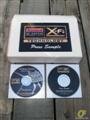
As you can see above, Creative has clearly marked this as a press sample, so too, the driver CD.
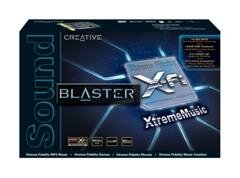
For comparison, heres a picture of the retail package.
Heres the card as delivered.
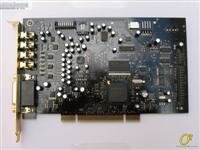
It is clear from the picture that there is only one internal optical drive connector on the card. Im already slightly disappointed.
Here's the back panel.

From left to right: Creative's proprietary 26 pin connector (for use with an X-Fi I/O console, aftermarket option), Rear speakers, Centre/Sub speakers, Front speakers, and finally the FlexiJack (Line In, Microphone, and Digital I/O) There is a footnote to the Digital I/O functionality on the Soundblaster website that reads,
Page 5 : Installation & First Impressions
Only two steps are really required. Insert the sound card into a vacant PCI slot. Install the drivers from the CD. Installation can be a bit of hassle if you have a previous installation of SoundBlaster software. Uninstall the old stuff first. Again, it should be noted that this is a Press Copy of both the card and the included CD. I did not have a retail version available to compare with. With that said, I have no idea what the differences might be between the press copy and a retail sample.
After popping in the installation CD youre greeted with a few full-screen splash pages, your select your country and language, and then youre at the install screen. There are only four selectable options during installation: Sound Blaster X-Fi (youll probably want to leave that one checked as it contains the drivers and control consoles), Creative MediaSource (thats the media player and organizer software), AOL on Desktop (I think we can all guess about that one), and finally you get the option to install the Doom 3 update for X-Fi (if you dont own the game, I think you could skip this one). Thats it, thats all. After installation, youre prompted to restart. All-in-all, installation is a pretty painless process, and thankfully not a lot of unnecessary software is installed without your knowledge in the process.
After firing the card in my main gaming box, I arbitrarily jacked up some Fatboy Slim MP3s and gave them a listen. I wasnt really expecting much. As much as Id like to say I wasnt instantly impressed, I was instantly impressed. Holy impressed. Clearly, Creative has made strides in sound quality. Since I was listening to MP3s, I thought Id try out the Crystalizer. The music was variable bit-rate, on the high end, 240 320kbps. This time, once again, I was impressed. Simply placing a check mark in the Enable 24-bit Crystalizer box, set at the default 50% setting made the vocals more brilliant, the bass a tad more full, and the overall clarity improved. It was like all of a sudden there was more air in the room. Despite my usual neutrality, I found myself enthused. More listening, more watching, more playing
Page 6 : Software and CPU overhead
Everybody probably already has a favorite media player/organizer; MediaSource 3 is included in the package, and although a capable bit of software, I just cant imagine many people who havent already been using it would make a switch. What you will find yourself using though, are the three consoles that reflect each operating mode. Ill have a brief look at the two consoles youll be using. The Entertainment console utilizes a clean design that is reasonably easy to navigate, and youre usually faced with a friendly slider, check box, and/or radio button to adjust each function.
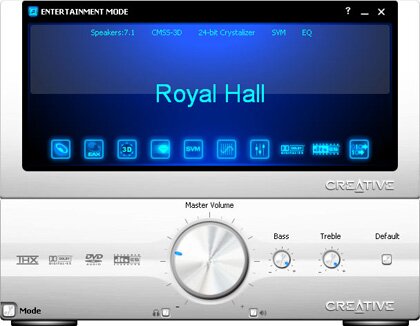
Across the bottom from left to right you can select the setup options for: Speaker and Headphone, EAX, CMSS-3D, Crystalizer, Smart Volume Management, EQ, Mixer, Dolby, DTS, and Digital I/O. The corresponding settings are indicated in the upper portion of the panel window. Given the tremendous variety of audio hardware, spatial characteristics, and personal taste available in the world, your mileage might vary considerably with the altering of the settings.
Im less keen on the unnecessary clutter of the Gaming console.
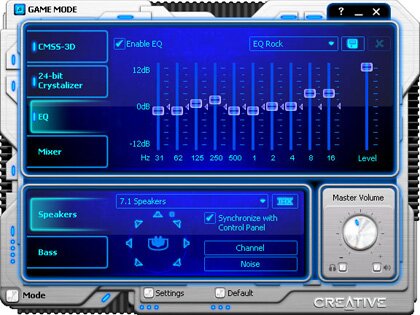
It works roughly the same way as the Entertainment console, so Im not sure why the folks at Creative thought to change the layout so much. I guess theyre looking to appeal to the hardcore gamer with the look. All the little blue buttons around the edge of the panel are just for show, they have no function. Id have preferred to have a consistent interface with a clear title bar showing which mode I was currently using.
For all the advancements and tools available to you in these consoles, in the end, after the increasingly less frantic honeymoon phase of your new acquisition, youll probably find the happy medium for your setup and for the most part always leave the settings to the flat end of your initial tweaking. After two months of previewing this card, Ive ended up pretty much leaving everything off. The only exceptions I make are the occasional switches made to accommodate different movie playback modes.
Im happy to report that using the Crystalizer, CMSS-3D, or the various speaker settings have no real impact on CPU utilization. Although I did notice some initial oddities depending on which mode I was using during what function, these discrepancies seemed to be minimized with the most recent driver update. As I didnt do any extensive CPU utilization comparisons, I cant say how much better the X-Fi cards will do compared to an on-board solution, but I can say that during CD playback with the Crystalizer engaged, I frequently reported zero percent CPU utilization. It would seem the X-Fi processor is doing its job efficiently.
Page 7 : Listening
For those of you that have read my earlier article on the Plextor PX-716A, you know I was impressed immediately with the advantage that this optical drive provided when playing back audio CDs. I will be using the same transport to evaluate the X-Fi Xtreme Music card. I will be using the sound card to listen to music, play games, and watch movies. Ill be reporting on what I hear. Ill leave the sound engineers from other sites to report back on the measurable quality of the card. Im only interested in the sound I hear.
Music:
Well the old saying that, You cant take back a first impression is true. Through a plethora of music I was undeniably impressed. But there is more to sound and the X-Fi card at hand than simple impressions, theres also the technology that lots of you will likely use, the Crystalizer. If you were to take a blind listen Id guess that a great many of you would, like me, be instantly quite impressed with the sound. To really test out the Crystalizer though I devised a series of listening experiments. Using a handful of different CDs, I ripped them to MP3 at 128kps and 320kps as well as loseless WMA, and then proceeded to A-B the output, comparing the original CD to the ripped files using a variety of Crystalizer settings. The music I used spanned a large number of styles, recording quality, and recording ages. It should also be noted that the tests were conducted using three separate sets of speakers and amplification, a set of Creatives own 2.1 speakers, the Altec Lansing GT-5051s I reviewed previously, as well as my Meitner pre and power amp through my DCM 1A speakers.
What initially sounded so good was tarnished a little when put under careful scrutiny. After countless hours comparing, Id have to say that while the Crystalizer does what it claims to do, which is expand previously compressed portions of a recording, it does so at the expense of clarity. This isnt to suggest this is an earth-shattering kind of problem, its just that when compared to the original, unprocessed CD, the Crystalized version sounds a bit soupy. That being said, you really do need to sit and listen carefully, comparing back and forth to detect it. Like anything in audio, there is a trade-off here, more dynamics or more clarity. The choice will ultimately be up to the listener.
Movies/TV:
One place that I was surprised by the benefit of the Crystalizer was during television watching. While I dont know much about how much the audio signal is compressed during television transmission, the benefit of using the Crystalizer during playback was pretty apparent in most television broadcasts. The general exception to this seemed to be sports, where Id guess that the sound might already be tweaked to highlight the action. CMSS-3D was a bit more of a mixed bag; occasionally during a TV movie for example, you could get a stellar 5.1 effect, placements being bang on, however on other occasions things could end up being very poorly placed or centre channel balance being skewed. When given a straight 5.1 signal from a DVD, the X-Fi card delivered exceptional sound and in pretty much every way topped the Audigy 2 I used for comparison.
Games:
Creative, EAX (now on its fifth incarnation), and gaming have always gone hand-in-hand, and the X-Fi only builds on that success. Though perhaps less noticeable when compared to the fidelity improvements made in straight music and movie playback, gaming sound is subtly improved and spatial effects have been tuned even more. Listening to the latest batch of games, Quake 4, Call of Duty 2, the F.E.A.R. demo, I couldnt help but be impressed with the accuracy and clarity the sonic picture the X-Fi paints. Games are generally so tweaked already, the use of the Crystalizer isnt required, nor is there any need in any current games to use CMSS-3D, what youre left with is just the pure, visceral, sonic force the developers had in mind when they created the games.
Page 8 : Conclusion
While some have stated that the PC sound business has been hampered by the lack of competition, and to some extent this is likely true, Creative has raised its own bar with the launch of the X-Fi line of cards. In every area, the X-Fi Xtreme Music has improved on the Audigy 2.
While Id personally like to see Creative make an audiophile specific soundcard, one that makes absolutely no compromises with the components, one that could be used in a traditional stereo setup, bypassing traditional CD transports and circuitry, instead, making a quiet PC the centre of an audiophiles listening room, there is no denying that the X-Fi line of cards gets us all significantly closer to that goal without sacrificing all of the other areas weve come to rely on our soundcards for. As well, I think there would be a lot to gain if Creative started the line-up of their cards at a much lower price point so that everyone has the opportunity to hear the difference in quality the X-Fi cards can make.
Creative has made huge strides in digital sound processing, and while there are purists that will always scoff at the idea, the direction that the Creative engineers are headed is an interesting one. I expect that the vast majority of X-Fi owners will be thrilled with the Crystalizer, and happy with the CMSS-3D processing. Im also sure that the gamers who have come to expect Creative to provide the best gaming solutions wont be disappointed as EAX keeps getting better.
If sound is important to you, by all means, invest in the X-Fi line. If you dont hear the difference between an AM radio and a live performance, stick to the on-board solutions. In the end, for people like me, who use their PC for everything, I cant really imagine a better jack-of-all-trades soundcard than the X-Fi Xtreme Music.
Advantages:
- Excellent sound reproduction from quality sources
- Interesting and successful sound processing solutions
- Audible improvement over previous generations
Disadvantages:
- High price of entry a barrier to X-Fi line-up of cards
- Some sources dont take advantage of advanced DSP
- More features than many listeners will use, or need
Many thanks to Creative for providing the sample for review and their patience in waiting for the publishing of this review.